
LAND & POWER THE SUMMIT
Sunday, November 17, 2019
Lafayette County, Mississippi
10 AM – Noon
Belonging to the Earth
An experiential workshop to engage with the power of the land with Lydia Koltai
The landing @ Entrance to Whirlpool/South Campus Rail Trails on Chucky Mullins/Coliseum Drive, South of Highway 6, Oxford
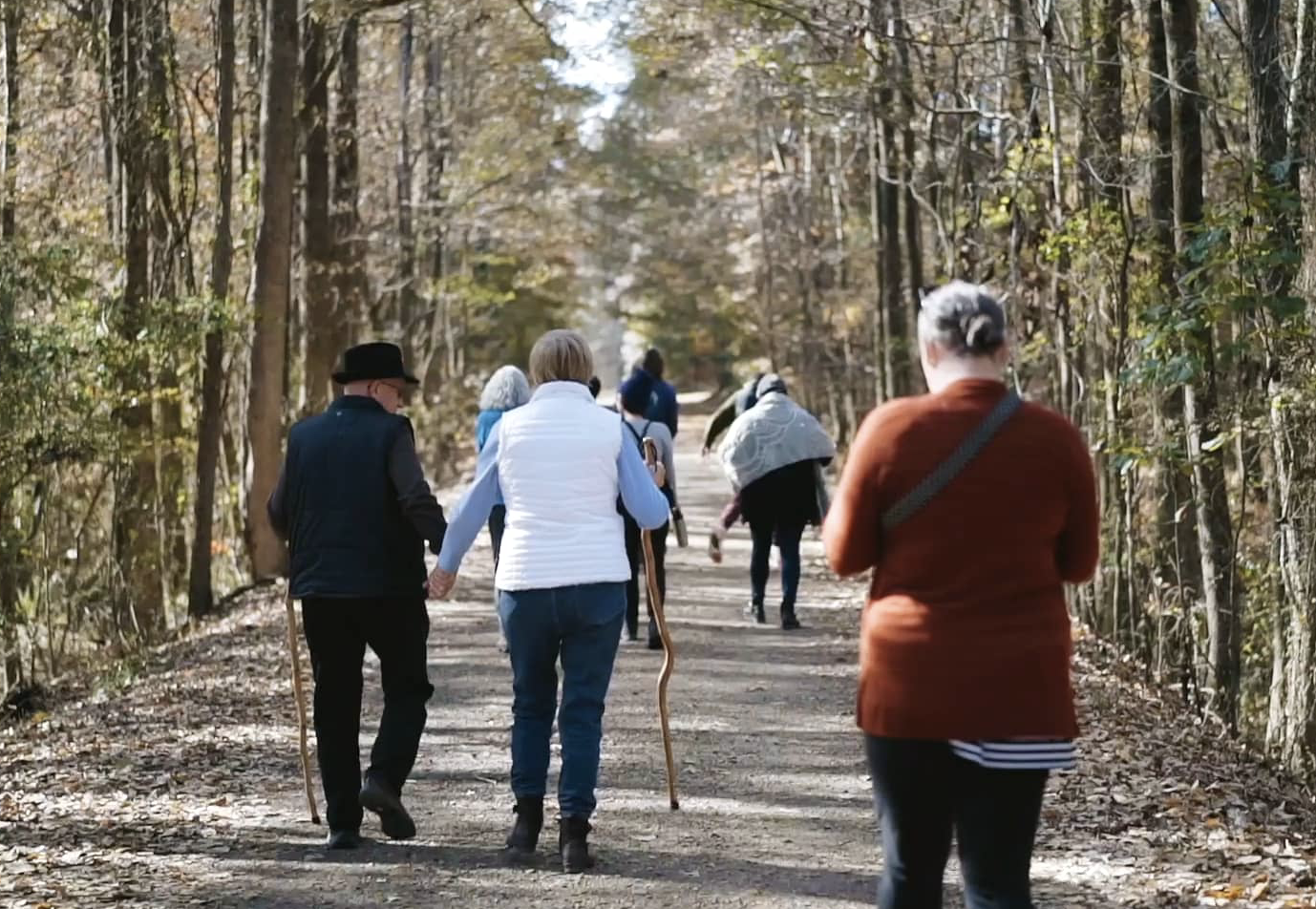
Participants experienced connection to the land they walk upon with an introduction to the tools of song, storytelling, prayer, plant medicine, foraging, bird language, fox walking, and sensory immersion in nature. We began with a Thanksgiving Address to offer gratitude to all the beings who make up the natural world. Koltai shared a couple of songs and stories about nature connection experiences from her own life. There was an opportunity to sample herbal medicines and wild foods from the land. Koltai spoke a bit about bird language and lead sensory exercise to become immersed in the world around us. Finally, participants moves out onto the land and experiences a sit spot, then came back together to share their experiences.
The Summit @ The Gordon Community and Cultural Center | 35 County Road 115, Abbeville
12:30 PM
Registration Begins
1 – 2:15 PM
Fair Exchange
Applying whole systems design towards building equitable systems of exchange, and a common wealth of resources and relationships in North Mississippi
Ben Koltai, Dr. Clifford Ochs, Dr. Robbie Ethridge, and Dr. James Thomas
Permaculture is a whole systems design science described as “consciously designed landscapes which mimic the patterns and relationships found in nature, while yielding an abundance of food, fiber and energy for provision of local needs.” Permaculture design provides strategies for growing food and building resources by utilizing the many streams of energy flowing through our ecosystems, rather than excessive human labor or harmful machinery. Work smarter, not harder.
Bringing together University professors from Anthropology, Biology, and Sociology, permaculturalist Benjamin Koltai will moderate this community conversation applying Permaculture principles and ethics (care for Earth, care for people, return of the surplus) toward an exploration of strategies for implementing equitable socio-economic systems in our bio-region. Sustainable development cannot be implemented without supportive “invisible” systems, including culture, law, land access, trade, finance, education, and media. Our goal is to develop “invisible” systems for North Mississippi that empower and encourage every individual to build regenerative “visible” systems, supporting our common wealth, health, and well-being.
Reflecting on the Past for a Better Future
A report on Lynching Memorialization in Lafayette County
Randon Hill, Effie Burt, Alonzo Hilliard, and Darren E. Grem
Lynching Memorialization in Lafayette County, a community group based in Oxford, has been working in partnership with the Equal Justice Initiative for the past two years to educate the community on some of the ugliest aspects of our past, recognize local victims of racial terror, and hold space for healing to occur. Hear four members of the group’s Steering Committee share why they got involved in this work, some of the outcomes and impacts they have observed thus far, their vision for the future of Lafayette County and intended next steps in this vital work. The discussion will touch on the history of lynching both regionally and locally, the intersection between racial terrorism and black land ownership, and how this work has impacted community members with direct and indirect ties to this history.
2:30 – 3:30 PM
The History of the Enslaved & Civil Rights through Movement, Dance, & Song
Jennifer Mizenko, Rhondalyn Peairs, John Reyer Afamasaga, Tysianna Jones, Angelica Wells, Emily Olsen, and Kaylan Sanders
September 9-15, 2019, members of the Lafayette, Oxford, University (LOU) community took part in a special workshop that exposed them to the history of the enslaved and Civil Rights at the University of Mississippi, through theatrical movement and dance. Find out how embodying this history opened the way for the participants to have a deeper understanding and appreciation of the history. The stories are no longer abstract, but real and viscerally experienced. The session will include the premiere of the documentary Moving Spirits, which follows the events of the September workshop.
The project was financially supported by Mississippi: The Dance Company, Mississippi Humanities Council, Office of the Dean of Diversity and Inclusion at the University of Mississippi, Yoknapatawpha Arts Council
North Mississippi Rural Legal Services
Litigation and history in land and power
April Grayson (moderator), Catherine V. “Ginny” Kilgore, and Ben Thomas Cole, II
Since its beginning as a clinic at the University of Mississippi School of Law in 1966, NMRLS has been one of the most important sites of legal advocacy for Mississippians otherwise unable to access legal aid. As many Mississippi cities and counties avoided or refused to uphold civil rights legislation, NMRLS has filled an important void, using tough litigation, counsel, and support to fight for Mississippians to have social, economic, and legal equality. This panel will screen a short compilation of excerpts from an ongoing NMRLS oral history project, as well as discuss the ways the organization has impacted issues of land and power—in redistricting, segregation, election, municipal, and housing cases—throughout its 53-year history.
3:45-4:30 PM
Land Through the Lens
Presented in partnership with the Oxford Film Festival
Filmmakers’ panel moderated by Melanie Lynn Addington, executive director of Oxford Film Fest & president of Mississippi Film Alliance
Look Away, Dixieland – Rebekah Flake
On February 23, 2019, a demonstration was held in Oxford by two neo-Confederate groups from out-of-state. They met at the war memorial on the town square for a demonstration and then marched in procession to a similar statue on the campus of The University of Mississippi. Their flags and rebel yells were met by the posters and chants of local residents and students standing in opposition. All were surrounded by media and law enforcement. Larger crowds were kept at bay by an active tornado warning, washed-out roads and a boil-water directive caused by relentless downpours in the preceding days. Rebekah Flake, the director of this experimental short film, grew up in this town is and is currently a faculty member in the University’s art department. This campus is considered a last hold-out for Confederate values, and the athletes still play under the name Rebels. Many students and faculty of color vacated the University the day of the demonstration in fear for their safety. The tension was as thick as the humidity. Look away, if you can.
TREES – Zaire Love
TREES is a short film and an ode to wise southern black women. It utilizes trees to symbolize black women in the South. They are everywhere you go but are rarely gazed upon, exposing their majestic stature and wealth of wisdom.
Connecting to the Land Through Tai Chi – April Grayson and Chris Aloia
The video is a collaborative work between T’ai Chi practitioner Chris Aloia and filmmaker April Grayson, filmed in the landscape of Lafayette County at Sardis Lake. It explores Chris’s T’ai Chi practice as a deep connection to land and space, drawing on the Chinese philosophy of the eight directions (Bagua) in Taoist cosmology.
Land and Legacy
A look at Black land ownership in Lafayette County
Rhondalyn K. Peairs
Recent books and article have refocused the attention of the general public on the state of black farming and food justice. In this cannon of research scant consideration has been given to the African-American landowners who maintained their landholdings against all odds and leveraged them to aid in community development and progress. This presentation will delve into the historical and cultural importance of landowning as well as highlighting significant Black landowners in Lafayette County past and present.
4:45 PM
Welcome
Marking the moment in song
Effie Burt
Dinner is served.
5:15 PM
Dinner presentation by Chicory Market
5:30 PM
Let’s Talk
A conversation of participants sharing their experiences with the CAPE residency
April Grayson, Effie Burt, Robert Saarnio, Jason Bouldin, Rhondalyn Peairs, Monique Davis, managing director of CAPE (moderator)
CAPE is a W.K. Kellogg-funded initiative of the Mississippi Museum of Art that uses engagements with artists, programming, and exhibitions to discuss issues of race and equity and increase understanding. This panel offers an opportunity to reflect with participants on the potential impact of a project like this in their community.
6:30 PM
Reaching the Summit
What the artist dug up along the way
daniel johnson
Residency artist daniel johnson offers a survey of the land traveled over the course of the project focusing on his considerations and process as an artist of Social Practice.
The Reception @ Burns-Belfry Museum and Multicultural Center, 710 Jackson Avenue East, Oxford
7:30 – 9 PM
Black Presence in Lafayette County
Presented in partnership with the Oxford Artists Guild
An exhibition of work by local Lafayette County artists reflecting on their own memories and the history of black presence in Lafayette County; portraits, landscapes, and gathering places. Refreshments provided by Chicory Market with a focus on locally-produced foods.
SPEAKERS
Melanie Lynn Addington has worked with the Oxford Film Festival since 2006 in various capacities and became executive director in August 2015. She also directs, writes, and produces films and serves on the Mississippi Film Alliance as president. She co-founded OxFilm, the Yoknapatawpha Arts Council‘s program to lend equipment to Oxford filmmakers.
John Reyer Afamasaga is a New Zealand-born expat currently living in the American South. He moved to Oxford in 2017 with his wife Michelle, and almost immediately began volunteering at the Oxford Film Festival. In 2018 he founded Three Times Dot Org a film production company and began working on the documentary films The Yard (2018) and Door Ajar – The M.B. Mayfield Story. Door Ajar won Best Mississippi Feature at the 2019 Oxford Film Festival for its world premiere and was invited to open and close the 2019 Tupelo Film Festival. The Yard (2018) was nominated for the John E. O’Connor Film Award of the American Historical Association in 2018. Afamasaga hopes to continue producing stories of his new home for the web and film. He is eternally grateful to the people of the South for letting him tell their stories. He is currently working on several projects which including, Moving Spirits – The history of the enslaved at the University of Mississippi and Southern Man – Men in the American South from 2018 to 2020.
Chris Aloia was born and raised in Brooklyn, New York, and has lived in Oxford for 14 years. He has a BA in Psychology, with a minor in Art, from University of Mississippi, and a Master of Public Health degree from Simon Fraser University. Chris had early exposure to Asian healing methods and philosophies, including studying karate and boxing in his teens. He has been doing T’ai Chi since 1998 and has studied under many well-known T’ai Chi masters. Chris currently is the instructor for the Oxford Park Commission’s Leisure Lifestyle Program T’ai Chi Class, and he works with Adults with Special Needs.
Jason Bouldin lives and maintains a studio in Oxford, where he works primarily as a portraitist. He obtained his bachelor’s degree in Art History from Harvard University, and received his studio training directly from his father, portraitist Marshall Bouldin III.
Ben Thomas Cole, II worked during two separate time periods in in the history of North Mississippi Rural Legal Services. The first was from 1976 to 1983 in which he served in the positions of Managing Attorney, Regional Attorney, Coordinator of Litigation, and a short period as Acting Executive Director. After serving as executive director of a legal services program in Arkansas, he returned to NMRLS and has served as the longest tenured executive director, from 1999 to the present.
Effie Burt
Monique Davis, a CPA and graduate of Howard University, is the managing director for the Center for Art and Public Exchange (CAPE), a W. K. Kellogg-funded initiative that uses artwork, exhibitions and programming as a vehicle to have conversations about race and equity. Davis is responsible for developing programming that expands visitor’s perspectives and inspires new understanding. She is deeply committed to the belief that art has the power to transform and inform us. Prior to her tenure at the Museum, Monique served as the senior program manager for Parents for Public Schools of Jackson. Her primary responsibility was to teach parents how to be effective advocates for their children. This was accomplished by creating workshops that helped parents navigate bureaucratic systems.
Dr. Robbie Ethridge received her Ph.D. from the University of Georgia in 1996 and took a position at the University of Mississippi the following year. Her areas of expertise are historical anthropology and environmental anthropology, with an area focus on the Indians of the Southern United States. She been interested in American Indians for most of her life, but did not discover anthropology until her freshman undergraduate year. From that moment, she has been devoted to the study of American Indians and other indigenous people, and especially to the study of their colonial experiences. After receiving her B.S. and M.A. in anthropology, she worked as a field archeologist for many years. It was during this time that she began to understand the full importance of interdisciplinary work, and especially the need to combine archaeology, history, and anthropology in researching and writing histories of the American Indians.
Rebekah Flake is a Canadian-American visual artist using lens-based media and curation to explore migration narratives and the psycho-social effects of borders. Raised in Mississippi, she references the inescapable persistence of history in the forms of public memorials and personal reflections. Flake holds an MFA in Photography and a Graduate Certificate in Documentary Arts and Ethnographic Practices from Tyler School of Art at Temple University, a BA from the University of Pennsylvania, and an MA from the Williams College Graduate Program in the History of Art. Her studio is based in Philadelphia, Pennsylvania, and Oxford, where she also teaches photography and digital media.
April Grayson is a filmmaker, oral historian, and racial equity practitioner. She has extensive documentary film making and oral history experience, dating back to 1995. She worked on several films and television documentaries, including Martin Scorsese’s PBS series “The Blues,” with directors Wim Wenders, Sam Pollard, and Charles Burnett, and “The Murder of Emmett Till” by Stanley Nelson. During that time, she also worked extensively in community documentary and oral history work, primarily as part of the William Winter Institute for Racial Reconciliation, where she was Documentary Educator from 2005 to 2009 and where she returned in 2013 and where she now serves as Director of Community and Capacity Building. Her oral history project on the integration of the University of Mississippi School of Law and Medical School, in conjunction with Kate Medley, won the Mississippi Historical Society’s Elbert Hilliard Oral History award. She has a Master of Fine Art (MFA) in Film from the San Francisco Art Institute, and her short films have shown in film festivals, galleries, and museums in the United States and Canada, Europe, Africa, and South America. Together with Dr. Roy DeBerry, she served as oral historian for the NMRLS oral history project, which completed its first phase in August 2019.
Dr. Darren E. Grem is associate professor of History and Southern Studies at the University of Mississippi, where he teaches undergraduate and graduate courses in 20th-century U.S. history, Southern history and Southern studies, and modern politics and culture.
Randon Hill is a born-and-raised native of Oxford. She is a recent graduate of the University of Mississippi where she earned a degree in both English and Spanish and held multiple leadership roles. One of her favorite projects right now is working with the steering committee for the Lynching Memorialization Project of Lafayette County.
Alonzo Hilliard is a University of Mississippi graduate and currently serves as COO for Sigma LOU Group, LLC. Hilliard is the founder of LOU Mercy Re-entry Ministries and is a Board Member and weekly volunteer for Interfaith Compassion Ministry. Hilliard is a Steering Committee Member for Project THRIVE. He is married to Theressa Hilliard, has 4 adult children, and 10 grandchildren.
daniel johnson is an independent artist, curator, and entrepreneur focused on agency, equity, and the emergence of consensus. johnson roots the creative process in deep listening and the articulation of the resonance present among the unfolding, intersecting stories of everyday life. Through reflection on the nature of belonging and facilitated community storytelling, johnson works with groups of people to harness their unique cultural expressions in a co-design process to disrupt power dynamics and realize shared intentions. johnson has designed and facilitated projects with partners across sectors. Collaborators have included the communities unfolding from the Jackson Medical Mall, Hinds County Schools, Millsaps College, City of Jackson Mayor’s Office and Planning Department, Operation Shoestring, Mississippi Museum of Art, MS Department of Transportation, and Midtown Partners CDC. johnson is a 26-year resident of Jackson, where his roots lie; both sides of his family going back generations in Central and Coastal Mississippi.
Tysianna Jones is a native of Brandon. After completing her undergraduate years at the University of Mississippi with a BFA in Theatre Arts, Tysianna went on to open her own dance studio located in Oxford, MS where she is the head coach and Director to over 30 dancers. She thanks her former professor and adviser Jennifer Mizenko for the limitless opportunities she has provided for her during her time at the university and post-graduation.
Catherine V. “Ginny” Kilgore was the founder and director for decades of NMRLS Elder Law Project and the annual Elder Law Conference and served as a pioneer in the area of elder law in Mississippi. She developed and directed the NMRLS/University of Mississippi School of Law Clinical Program, Also, she was part of a statewide coalition of stakeholders in the area of domestic violence in the early ’80s that resulted in the first legislative remedies for victims of Domestic Violence and was a resource to those in the state who were establishing the first shelters for victims of domestic violence. She recognized and litigated important public benefits issues that were occurring on the state and national level by networking with the LSC backup centers and coordinating with statewide efforts of legal services advocates. She was instrumental in establishing better standards of practice in the NMRLS administrative cases and providing more training opportunities for paralegals and attorneys in administrative law. She also worked on important cases in the areas of employment discrimination and prisoners’ rights during periods of time when LSC grantee programs were allowed to work on class action cases and prisoners’ rights case.
Ben Koltai
Since childhood, Lydia Koltai has been a devoted student and lover of the Earth. A graduate of New College of California’s Culture, Ecology, and Sustainable Communities program, with an emphasis on Sustainable Agriculture, Lydia has also completed Common Vision’s permaculture design course, Penny Livingston-Stark and Jon Young’s Regenerative Design and Nature Awareness program, and a shamanic herbal apprenticeship with herbalist Susun Weed. Additionally, she has spent months travelling across the country as a Willing Worker on Organic Farms (WWOOF) and has continued her herbal education through online and in person courses over the past several years. Lydia is an herbalist, gardener, homeschooling mother of four amazing kids, community organizer, nature awareness educator, owner of Elder Moon Apothecary and enthusiastic sharer of the Earth skills she has gathered with her community.
Zaire Love is a multidisciplinary artist, filmmaker, and TEDx speaker. Her work is an ode to being black and southern in America. Many of her works aim to honor and amplify the voices of southern black women because they have always had “cornbread” to share. Zaire is a graduate of Spelman College [B.A. in Theatre] and Houston Baptist University [M.Ed in Curriculum and Education]. She is currently pursuing her MFA in Documentary Expression from the University of Mississippi.
Jennifer Mizenko is a professor of Dance and Movement for the Actor at the University of Mississippi. She has a B.A. in Psychology from Kenyon College, and an M.A. in Dance from The Ohio State University. Jennifer is a Certified Teaching Member of Alexander Technique International also a Laban Movement Analyst certified by LIMS. One of Jennifer’s personal missions is to use her knowledge of movement to create projects and workshops that shed light on social injustice, and help create compassion and understanding in the participants – literally putting people in someone else’s shoes.
Dr. Clifford Ochs
Emily Olsen
Rhondalyn Peairs is an Oxford native, secondary educator and local historian. Her passion for the complex history of Mississippi and its people started early and runs deep. Peairs is a graduate of Tougaloo College and has done graduate work at the University of Southern Mississippi, where her research culminated in the thesis “Resisting in the Storm: Black Landowners in Mississippi from 1930 to the Present.” Her primary areas of research include the Post-Reconstruction American South, Civil Rights, the legacy of race and enslavement, as well as agricultural, women’s and oral history. She previously served as documentary projects coordinator and documentary educator with the William Winter Institute at the University of Mississippi. Currently, she is working on a M.A. in Southern Studies at the University of Mississippi and runs her heritage tourism and educational services business, HISTORICH. HISTORICH seeks to connect communities and visitors alike with the rich and complex history of North Mississippi through experiential learning opportunities. Patrons and visitors receive a more inclusive narrative of Mississippi history that privileges marginalized stories of those who have been erased from the traditional Southern narrative. Peairs is a descendant of African American farmers and landowners in four Mississippi communities through five generations. One of her grandfathers was a plaintiff and recipient (posthumously) of a distribution settlement in Pigford v. Glickman, the class action lawsuit filed against the USDA citing racial discrimination in its allocation of farm loans and assistance. Since the settlement of this lawsuit in April 1999, almost $1 billion has been paid or credited to more than 13,300 farmers under a consent decree. This makes Pigford the largest successful class action lawsuit against the U.S. government in history.
Robert Saarnio was educated in architectural history and fine arts at Harvard University, with a Master’s degree in Historic Preservation from the University of Pennsylvania. His museum career began in 1995 at the Peabody Essex Museum as Curator of Architecture, and has included successive roles of Curator, Deputy Director, and Director at Cranbrook (Michigan), Johns Hopkins University (Maryland), the Doris Duke Foundation (Hawaii), Honolulu Museum of Art (Hawaii), and since 2012 here at the University of Mississippi. One intervening year (2005-2006) was spent as a National Endowment for the Arts Rome Prize Fellow at the American Academy in Rome, Italy. And two years in Hawaii as a Major Gifts development officer at the University of Hawaii Foundation.
Kaylan Sanders is a resident of Jackson. She is a 2019 graduate of Jackson Academy, and is currently enrolled in the University of Mississippi as a biology major/chemistry minor. She has been dancing since she was 6 years old, and is a part of the dance ministry at New Jerusalem. She is also a part of iDance Academi and has participated in its productions and conference. Over the years, her love of dance has grown, and she plans to continue dancing in years to come. After she graduates, she plans to attend medical school and become a sports medicine doctor.
Dr. James Thomas was born and raised in Kansas City, Missouri, about three blocks away from the historic ‘red-line’ of the central city, 63rd and Troost, which was used by real estate and government officials to demarcate white and nonwhite neighborhoods. His mother was a leader of a neighborhood coalition that stretched across this historic dividing line, and he was often struck by the contrast between the interracial social space of the neighborhood meeting, and the intra-racial makeup of the block where our home was situated. In addition, riding the Metro (our city bus system) every day, he grew a strong appreciation for the diversity of urban life – economic, social, cultural, and political. His mother, a college librarian for 37 years, helped cultivate his interests in reading, writing, and activism. From Kansas City, he attended the University of Missouri in Columbia, where he graduated with a B.A. in both Psychology and Sociology in 2004. For the next year, he worked as a Youth Specialist with Missouri’s Division of Youth Services, counseling juvenile felony offenders in a minimum-security group home in Columbia Missouri. In 2005, he re-enrolled at the University of Missouri as a graduate student in the Sociology program. Falling in love with the process of critical inquiry and the pursuit of knowledge, he decided to continue his studies after obtaining his M.A. in Sociology in 2005, sticking around for his Ph.D. in Sociology, which he finished in 2011 along with a graduate minor in Women’s and Gender Studies. His dissertation research focused on the role of stand-up comedy venues in the production of contentious politics. He conducted ethnographic fieldwork at three different sites where stand-up comedy took place: a professional comedy club, a self-described punk/rock/horror/sci-fi bar that hosted a weekly amateur comedy show, and a popular drag revue at an LGBT nightclub. Upon finishing his Ph.D., this research served to frame his first full-length book project, Working to Laugh (Lexington Press, 2014), in which he situates the stand-up comedy club within the larger context of urban nightlife. Taking what Michael Ian Borer describes as the “urban culturalist perspective”, he interrogates the dynamics between space, power, and cultural practice within these scenes. Drawing conceptual strength from Michael Hardt and Antonio Negri, he frames the work involved in the production, distribution, and circulation of collective feelings of ‘good times’ within stand-up comedy clubs, and urban nightlife more generally, as a form of affective labor. He then argues that it is affective labor which contributes to, and contests, the reproduction of racial, class, and heteronormative orders within urban nightlife.
Angelica Wells
