
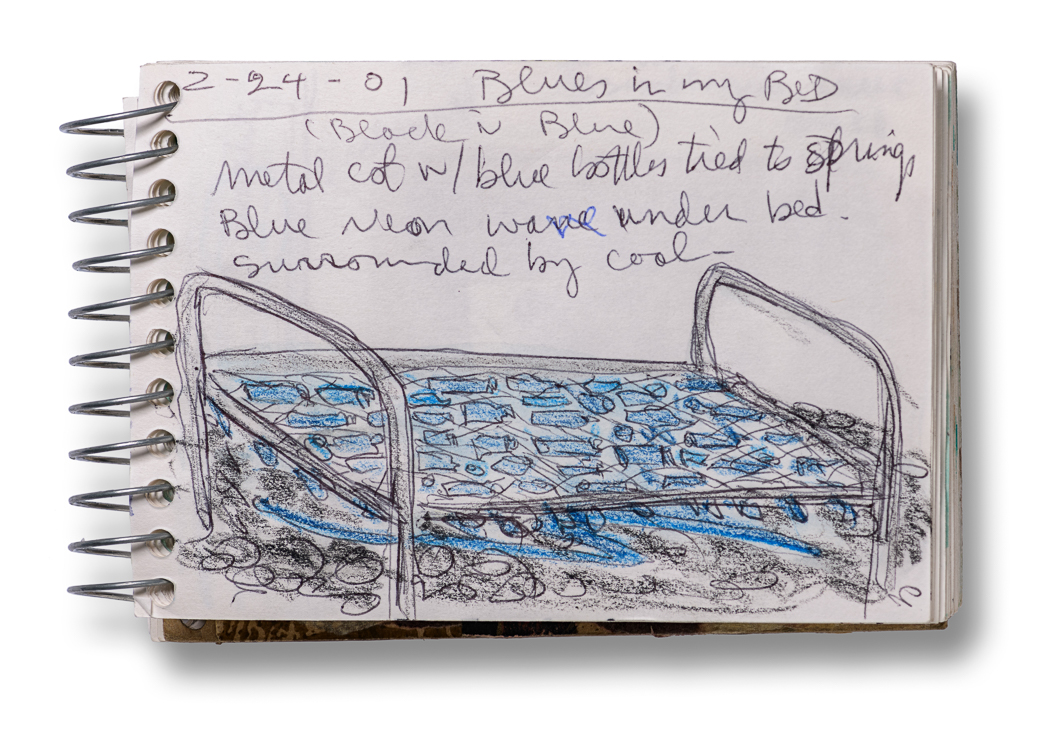
As the pandemic hit and museum professionals were faced with new challenges of limited access to their collections, working virtually, and travel restrictions, we had to come up with innovative and collaborative solutions for typical museum activities. Traveling exhibitions such as Betye Saar: Call and Response were impacted the most by these obstacles. Not only were schedules affected as museum doors were shuttered, but museum professionals had limited access to their exhibitions—especially when an exhibition traveled from its home institution.
Usually, a courier from the home institution (in this case the Los Angeles County Museum of Art) would travel with the exhibition. The courier has an intimate knowledge of these works of art including previous damage and an artwork’s inherent fragility. Composite objects (objects made from numerous material types) can face complications during travel as each material will react differently to the vibrations and the temperature and humidity changes in transit. For example, blue bottles glued to a flexible metal cot do not always stay in place.
Due to these complications and Los Angeles County’s travel restrictions, LACMA requested a local conservator be on hand to stabilize the artwork for display. Conservators use their knowledge of the chemical composition of the artwork and fine motor skills to formulate a treatment to stabilize and repair artwork as necessary.
As one of five conservators in Mississippi, I was able to examine the artworks of concern to the conservators at LACMA and stabilize Woke Up This Morning, the Blues was in My Bed. All of the blue bottles had to be examined for any detachments from the cot. Any loose bottles needed to be adhered. Any adhesive chosen must be invisible to the viewer, strong but flexible to hold the bottle in place, able to be taken off in the future, and not break down over time. The adhesive was carefully added to the detached bottles with a fine brush. Once the bottles were stabilized, Woke Up This Morning, the Blues was in My Bed could be safely exhibited.
For more information about the field of conservation, visit the American Institute for Conservation at www.culturalheritage.org.
Post by:
Kathryn Etre
Director of Conservation for the Mississippi Department of Archives and History
