

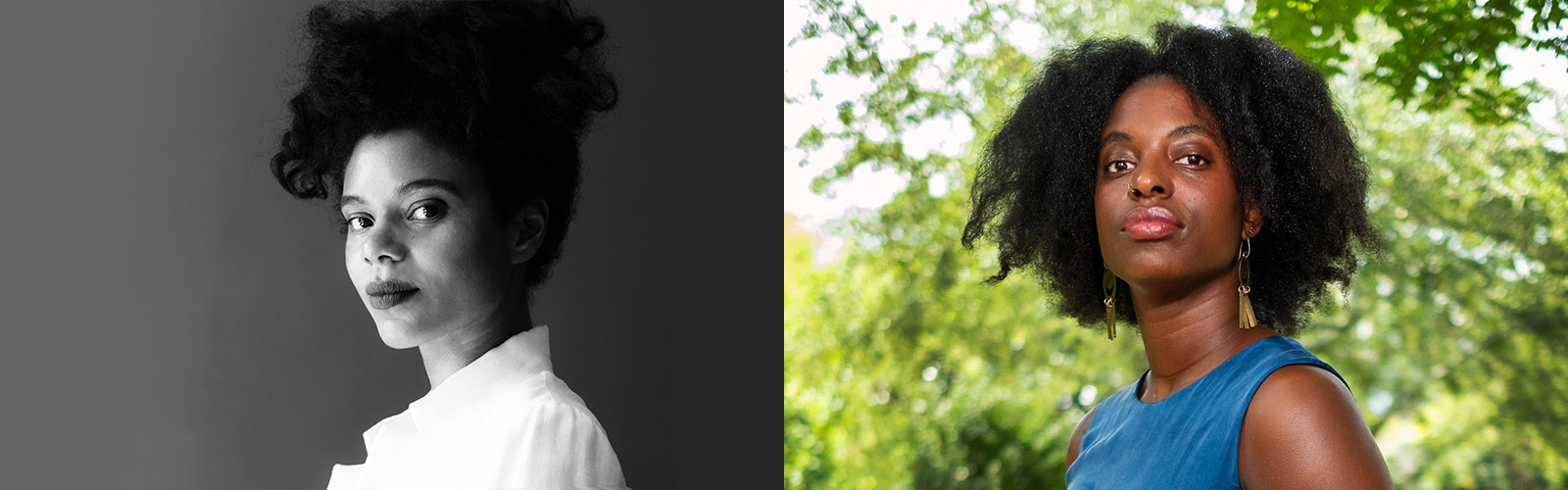
Prior to the opening of A Movement in Every Direction: Legacies of the Great Migration, MMA’s Education team sat down with co-curators Jessica Bell Brown and Ryan N. Dennis. Learn more about how the exhibition was created, the collaborative process with MMA and BMA, with the co-curators and artists, and with communities in this conversation. This interview is a part of the exhibition guide, a free publication that will be available at the exit of the exhibition. Also included in the guide are artists’ backgrounds, process, and artwork images; pages for reflection; and a conversation guide for continuing discussion about the exhibition themes.
EDUCATION TEAM: How did you start this exhibition?
RYAN N. DENNIS: So, I guess we’ll just go ahead and jump in. We came to this exhibition through it being a kernel of an idea from the Mississippi Museum of Art (MMA). I joined the MMA in spring 2020. Jessica joined the Baltimore Museum of Art (BMA) in fall 2019. When we joined the teams, we expanded the idea and started investigating what artists we would like to be in dialogue with around the Great Migration. So much of this exhibition has developed by following the lead of artists and expanding that outward.
JESSICA BELL BROWN: We asked ourselves early on: What hasn’t been said about the Great Migration, and how do we use that as a starting place? Are there certain givens about the Great Migration that we could pick apart? We had no trouble doing that because our artists came back to us with nuanced, complicated, beautiful project proposals that stretched our thinking.
ET: What were your connections to the Great Migration, coming into this project?
RND: I think, being a Black American, we’re all connected to migration and the story of the Great Migration. My family, on both sides, is from Louisiana and Texas, and parts of Alabama. They stayed in the South. The part of the Great Migration narrative that folks left the South and went north, that’s not my history. For those few family members who left, they went west to California in the second wave of migration.
JBB: Like Ryan, I’m from the South; most of my family stayed in the South, except distant cousins in Detroit, or Ohio, or even Texas. The Great Migration was something that I understood historically but not in a deeply personal way.
RND: Your question reminds me of one of the first prompts we asked artists: to share with us their personal connections to the South, or to this historical phenomenon. And we saw how their practices as artists have been impacted by the stories of their own pasts and histories. This exhibition links stories of the past, present, and future. The objects and the story are really side-by-side, running parallel to one another.
Everyone has expressed gratitude about being asked to start from such a personal place, because it’s rare in contemporary art, especially as Black artists with such prominence.
JBB: Many times, artists shy away from starting with the personal, because it might assign the work specific interpretations, or pigeonhole them despite the expansiveness of the art.
ET: You point to that expansiveness geographically and conceptually, too, by calling the show A Movement in Every Direction: Legacies of the Great Migration.
RND: In American history, the Great Migration has such deep reverberations. The title of the exhibition makes the point that migration is ongoing. Look at what’s happened with the pandemic, which has forced all types of movement. Many factors can make migration mandatory: it’s involuntary, and it’s voluntary. In some ways, I have this new lens about migration. It’s impacted by policy. It’s impacted by natural occurrences. It’s impacted by violence.
But on the flip side of that, it’s also impacted by love and care and ways to reconnect and create opportunities to build when an environment feels unstable. I’m still thinking on that point, but maybe Jessica, pick up this alley-oop.
JBB: In many ways, migration is about place. Place is the culmination of a migratory act. And sometimes folks are literally inventing or creating a new place.
RND: And the show prompts people to understand that the history and possibility can repeat, if there’s a space for that self-reliance or finding ways to be in community that allow people to thrive. And not just thrive economically, but thrive educationally, culturally, and beyond. The lessons are bountiful.
ET: What are some of the lessons that have shifted your practice as a curator?
JBB: This project is a behemoth and has been a true lesson in collaboration. At the baseline, there’s Ryan and me, our collaboration with artists, and our collaboration with museum colleagues. There is deep personal investment in this show, and among our intersecting communities and audiences.
I’ve learned what can happen when you surrender to shared ownership around a project. We’re all the better for it. So many times, curators are put on a pedestal, and their shows are all about their own ideas or the ways they see art history. And this is not that show at all. And I love it for that. Because it really lives and breathes a collaborative spirit.
I will say never have I had as many gut checks with Ryan or in general as we’ve had working together.
RND: For sure.
JBB: There is an ethics to curatorial work, especially when you are caring for people and holding their stories. That will be something that I will certainly live with, sit with, practice through and through as I move forward.
RND: Jessica and I strive to bring care and sensitivity to our work, and truly check in with one another, our teams, and our artists.
Being stewards of a story that we are really trying to expand, that maybe most people know as one thing, and having the responsibility to share that and allow for multiple points of engagement is really important and an ongoing meditation. Because you want to make sure it’s being done properly, with care, and with love, and with criticality.
ET: You mentioned holding a story; what does that mean for you?
JBB: I think it means to be receptive and to be curious. It means to be attentive and always look for the threads of connection. Holding a story is a practice. It’s something that’s not just done when the object is finished and it’s on view. It’s a practice that’s rooted in relationships.
RND: And I think to hold a story as two Black women maybe it’s something that we…look, I’ll just speak for myself. It’s something that happens maybe as an act that sometimes we don’t even know we’re doing, but it’s embedded. It’s part of an ancestral arc, too. The ways in which these stories show up in my body are connected to my grandmother, my great-grandmother or grandfather, et cetera.
To hold a story feels spiritual. And these artists are holding stories from their families that they are willing to share with us in really dynamic ways.
JBB: Totally. And holding that story, holding it and then sharing that with us and then sharing it with the world is the most beautiful thing, and it just makes you even more proud to carry it.
ET: That’s beautiful. And it calls to mind how stories take us places or connect us to places. Another abstract question for you: Where are we going with this show? Where is this exhibition taking us?
RND: I think the exhibition is taking us in a few different directions. Much like the Great Migration was not one path, I think this exhibition allows us to see people and artists in many ways and connect to a historical moment while also showing us that migration is not stopping.
Where are we going with this show?
JBB: I want to answer this question literally because there’s power in naming all the places. This show is taking us to Alabama; is taking us to North and South Carolina; is taking us to the South Side of Chicago and Detroit; is taking us to Blackdom, New Mexico; to Mississippi; to Los Angeles. It’s taking us to South Florida, and Kentucky, and Tennessee. It’s taking us to Okinawa, to Vietnam. It’s taking us everywhere. It’s spanning histories but always connecting to the present.
The show complicates any kind of straightforward or linear understanding of a place in time; it offers a beautiful way to think about how we, as people, experience time, place, and each other in these interconnected ways.
RND: My hope is that the show invites people to investigate where their families’ histories are within this time period and to this day. My hope is that people will have more inquiries into family relics, photographs, and archives. When you know more about your people, you begin to know more about yourself; you stand a little taller.
I want artists to feel stretched and rejuvenated by this exploration. They are creatively pushing to work in more expansive ways—through scale and material. This show is monumental. We not only get to bear witness to their work, but also have a responsibility to them as people. We want them to feel proud of us and their contribution as we hold their stories.
