

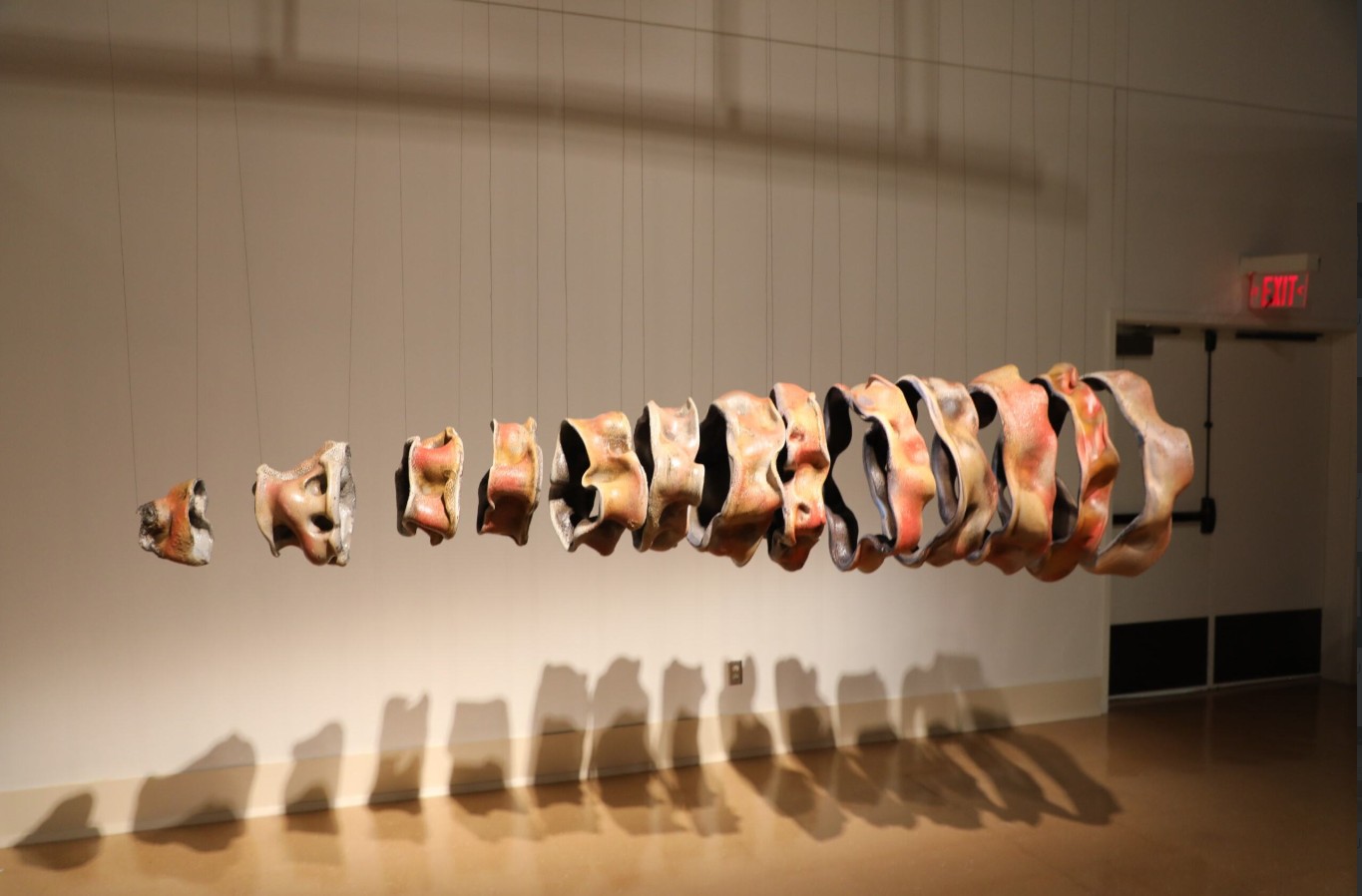
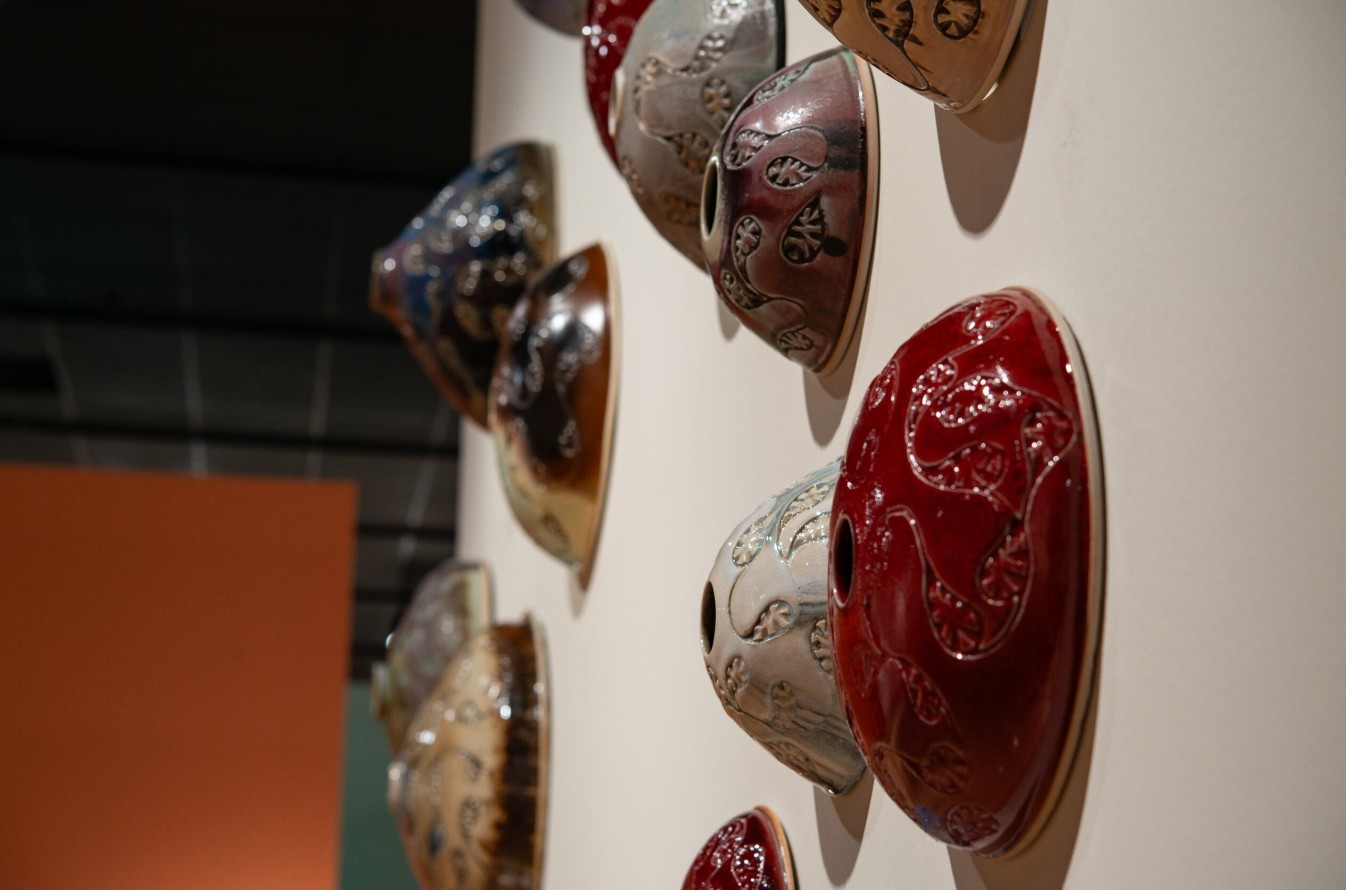


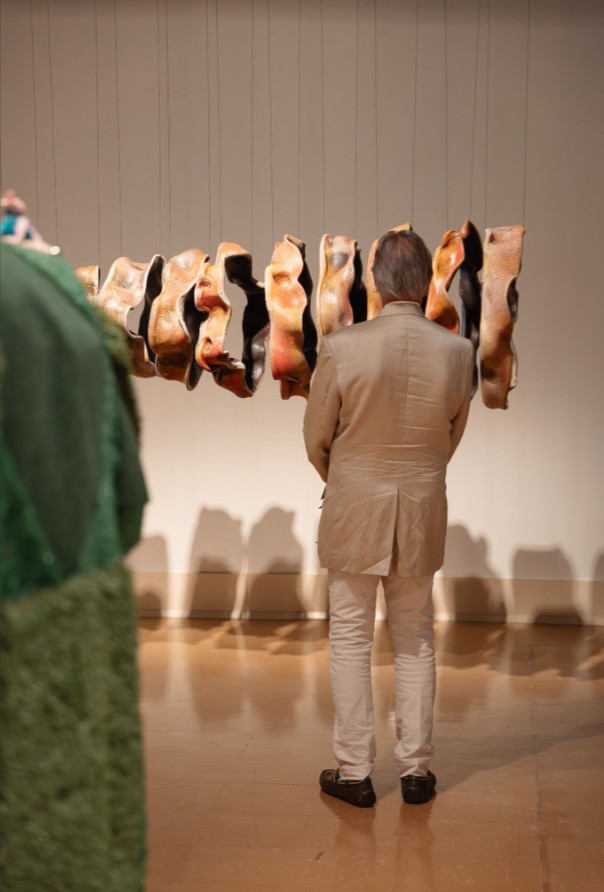
A first-generation immigrant born in Taiwan, Allen Chen moved to Los Olivos, California, at age twelve. He earned a BFA from San Jose State University and an MFA from The University of Notre Dame. He has been a long-term artist in residence at Mendocino Art Center in California, Red Lodge Clay Center in Montana, and Lawrence Arts Center in Kansas. From 2012 to 2014, Chen served as an assistant professor of ceramics at Central State University in Ohio and is now an associate professor of ceramics at the University of Southern Mississippi. Currently, Chen is interested in how vessels contain and transport content and how that relationship alters both properties. In his work, characteristics of vessels are expressed and revealed in response to the changing environment. The technical aspect of clay body formulation, ceramics surface treatment, and sculpting processes is the heart of Chen’s studio activity. Through installations of suspended ceramic vessels, he invites viewers to explore possible experiences by moving physically around the sculptures.
Contributing writers were encouraged to pen texts using the style, voice, and format of their choice. The resulting suite of poetry, journalistic and critical prose, creative essays, and personal reflections offers diverse perspectives on the artists, their practices, and their lives.
A Note from the Curator
Whether they are legibly utilitarian or abstract artistic expressions, Allen Chen’s ceramic works often refer to bodies. The artist sees his ceramics as living beings, molding them in expressive and responsive ways and often displaying them in multiples. This autobiographical note was written to assist the artist in unpacking his own complicated relationship to the concept of home as an immigrant whose life is lived between countries, cultures, and contexts.
Allen Chen on Himself
“Between Making and Belonging”
My paternal grandfather was a schoolteacher in China who enlisted in the army during World War II, fighting and surviving the war with Japan. During the chaotic years of the conflict, he frequently relocated his family to evade Japanese occupation. In 1949, he fled communist China with his family for the island of Taiwan when my father was twelve years old. Through hard work and determination, my father excelled academically and graduated from a top university for teachers (National Taiwan Normal University). He worked as a part-time substitute teacher while also working at a textile company; years later, he would go on to own a successful international trading business. As tensions between China and Taiwan escalated, he arranged for my mother and me to immigrate to the United States when I was twelve years old, hoping to provide greater security and opportunity for his family.
Growing up in Southern California with my mother, I saw my father exemplify hard work and exploration, while my mother taught me how to connect with others and build a sense of belonging as we assimilated into American life. This dual sense of movement and settlement continues to guide my own path. The opportunities my parents created for me laid the foundation for my development as both a ceramic artist and a teacher.
The first ceramics class I took was at a junior college in Santa Barbara, during my freshman year. I remember my botany professor explaining the particle sizes of minerals ranging from the largest (a rock) to the smallest (dust). “Do you know what is finer than dust? In fact, the finest mineral particle on earth is clay! If you have the opportunity, take a ceramics class! It’s the funnest thing you’ll ever do!” he declared. So it was by pure suggestion that I took intro to ceramics, and within months, everything fell into place as I quickly discovered an almost inexhaustible desire and capacity to work with clay. It became clear to me that, with enough hard work, I could have a career as a ceramics teacher—but it would take years of movement and resettlement to realize that dream. Through school, residencies, workshops, and university teaching positions, I had the good fortune to migrate from California to Indiana, from Montana to Kansas, and eventually from Ohio to what is now my home in Hattiesburg, Mississippi.
I’ve been teaching ceramics at the University of Southern Mississippi (USM) since 2014. It only recently occurred to me that I’ve now lived here longer than anywhere else. But my idea of “home” has changed. What once meant belonging, origin, or permanence now feels more like a continuum—a state of flux. Home is no longer a fixed point. It is a process. For me, home is a balance between exploration and belonging, grounded in work. Over the past eleven years at USM, my practice has been deeply integrated into teaching, research, and service—exploring ceramic processes, mentoring students, and engaging with the community. For the 2025 Mississippi Invitational, I’m offering a new body of work that has emerged from this ongoing rhythm: a reflection of the place where I live, the people that I work with, and the ideas that I continue to shape in clay.
Addendum
My maternal grandfather was a farmer in China who also joined the army during World War II. He too relocated to Taiwan with his family when my mother was five years old. My mother inherited a spirit of exploration from him and always encouraged me to pursue my dreams.
I say this because I see the duality in my parents’ roles in raising me but also recognize how both of them experienced similar journeys, and how both of them shaped my own path through their resilience and experiences. While I experienced my mother as a nurturing and connective influence on my upbringing, I also want to acknowledge that she was every bit an explorer and hard worker in her own right.
These experiences of migration, adaptation, and continuous movement have deeply influenced the way I approach ceramics. I create vessels, sculptures, and installations that draw inspiration from floral, seedling, and anthropomorphic forms, connecting the physical act of making to the human instinct for growth and transformation. My work often embodies a sense of duality—reflecting the tension between the utilitarian and the aesthetic, the organic and the mechanical, the past and the present. The tactile and responsive nature of clay allows forms to evolve and adapt to the environment of water and fire, much like people do emotionally. Through this practice, I am able to translate the lessons of resilience and belonging that I learned through my family’s journey into tangible, living works of art.
