
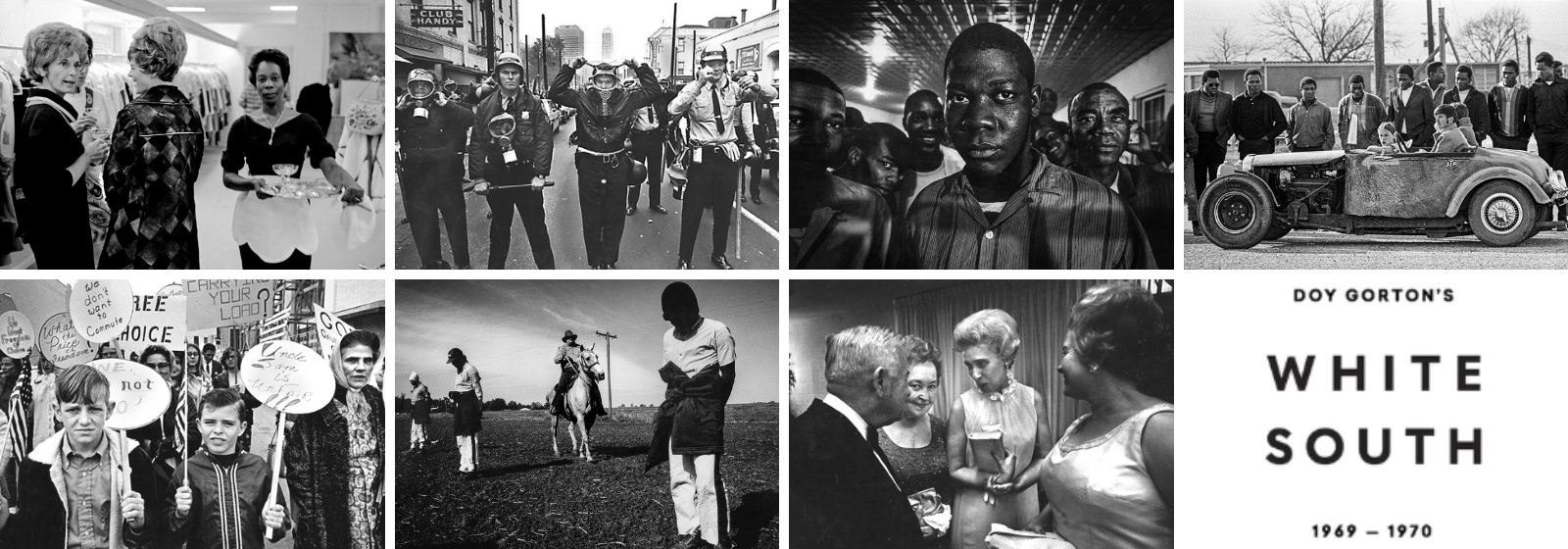
Doy Gorton’s White South was photographed in 1969-1970 at a time of great cultural upheaval. Martin Luther King Jr. and Robert F. Kennedy had been assassinated, the culture wars raged, racial segregation was outlawed, and the postwar generation stood bitterly divided. Gorton’s photographs from this period offer a stark study of Southern whites in the final days of legal White Supremacy—on the cusp of a new era, when everything was in flux.
Join author and Trustee W. Ralph Eubanks in conversation with Doy Gorton and Jane Adams to discuss their new release White South and its contemporary resonances.
Schedule of Events
- 5:30 PM – Doors Open, Cash Bar Available
- 6 PM – Panel discussion begins
Doy Gorton is a photographer born in the Mississippi Delta in 1942. Raised in an environment of privilege amid “legalized white supremacy,” Gorton turned against the system he grew up in by engaging with the Civil Rights movement during the 1960s. He was expelled from the University of Mississippi for his involvement in civil rights activities, after which he joined the Student Nonviolent Coordinating Committee (SNCC). His work with SNCC in various Southern states, including Southwest Georgia, Selma Alabama, and McComb Mississippi, included voter registration and photographic documentation.
In 1969, Gorton embarked on a project to photograph the white South, aiming to capture a more nuanced view of his home region. His photography during this period, spanning from 1969 to 1970, explored the lives of white Southerners, focusing on class and caste issues as much as race, providing a perspective on how economic and social changes affected the region. His work was inspired by American photographer Walker Evans, known for his respectful and straightforward depiction of people during the Great Depression.
Gorton worked as the Chief Photographer for the Philadelphia Inquirer and later became the White House photographer for the New York Times, covering the Carter and Reagan administrations. His photography career also extended into film, contributing as a special photographer for movies like “Glory” and “A River Runs Through It.” He has also worked with various music companies on album art for Fleetwood Mac, Canned Heat, Janis Joplin and other artists. He was the editor on “Day in the Life of the Soviet Union” as well as “A Day in the life of America” – a massive, unprecedented, photographic documentation of these entire nations in one 24-hour day with over 200 photographers from throughout the world.
Currently, Gorton is involved in the upcoming book “Doy Gorton’s White South” that draws from his work in 1969 – 1970. The book will be published in February of 2025 by Fall Line Press of Atlanta.
Jane Adams, born and raised in rural Jackson County, Illinois, earned her B.A. from Southern Illinois University Carbondale (SIUC), later obtaining a PhD in Anthropology from the University of Illinois Urbana-Champaign. Adams joined the faculty at SIUC in 1987, where she taught for 23 years until her retirement in 2010.
Her academic work focused on rural life transformations, particularly in Southern Illinois, and she published several influential books on the subject. Her anthropology research for the past several decades, in collaboration with documentary photographer D. Gorton, has focused on rural Illinois and the white South.
Adams was an organizer for the Students for a Democratic Society (SDS) from 1965-1969, serving as National Secretary in 1967. Reflecting her commitment to social justice and community engagement in 1960-61 she participated in desegregating Carbondale’s public accommodations and was a 1964 Mississippi Freedom Summer Volunteer. Post-retirement, she continued to be a dedicated teacher, scholar, and community activist, notably serving on the Carbondale City Council and Park District Board of Commissioners and advocating for sustainable farming through her involvement with the Illinois Stewardship Alliance.
Ralph Eubanks is the faculty fellow at the Center for the Study of Southern Culture at the University of Mississippi. He is the author of A Place Like Mississippi: A Journey Through A Real and Imagined Literary Landscape as well as two other works of nonfiction, Ever Is a Long Time and The House at the End of the Road. A writer and essayist whose work focuses on race, identity, and the American South, his writing has appeared in Vanity Fair, The American Scholar, The Georgia Review, and The New Yorker. He is a 2007 Guggenheim fellow and a 2021-2022 Harvard Radcliffe Institute fellow.
