
2021 Artist-in-Residence: Shani Peters
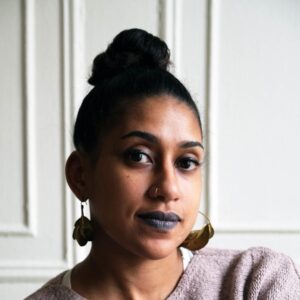
Shani Peters (b. 1981, Lansing, MI) is a multi-disciplinary artist based in New York City. She holds a B.A. from Michigan State University and an M.F.A. from City College of New York. Peters has presented work in the U.S. and internationally at the New Museum; the Schomburg Center for Research in Black Culture in Harlem; Seoul Art Space Geumcheon in South Korea; the National Gallery of Zimbabwe; and the Bauhaus Dessau in Germany. Selected residencies include those hosted by the Lower Manhattan Cultural Council, Museum of Contemporary Art Detroit, The Laundromat Project (New York, NY), and Project Row Houses (Houston, TX). Her work has been supported by the Foundation for Contemporary Arts, the Rauschenberg Foundation, Rema Hort Mann Foundation, and the Joan Mitchell Foundation. Peters is a faculty member at City College of New York, Pratt Institute, and Parsons School of Design focusing her teaching at the intersection of art, design, and social change. She is a co-director of The Black School, an artist initiated experimental art school in New Orleans that has led 100+ workshops since 2016.
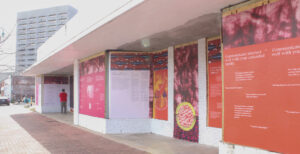
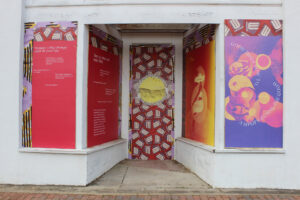
Peters embarked on a multi-part project, Collective Care for Black Mothers and Caretakers. Incorporating aspects of her multi-faceted community-based practice, Peters’ public, project-based, collaborative work considers painful truths and creates opportunities for collective momentum toward learning, wisdom sharing, and community exchange. Her process is informed by her lived experience and in-depth research as she examines the politics of shared society to reveal individual and community approaches to managing the weights on and demands of Black mothers and caretakers. Her culminating form, Collective Care Companion for Black Life, can be viewed here and in a compelling installation on the 200-block of Farish Street.
2020 Artist-in-Residence: Charles Williams
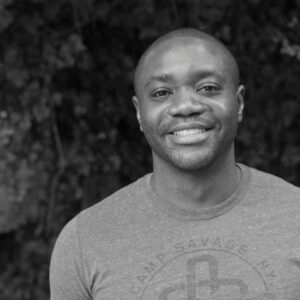
Charles Williams is a contemporary visual artist from Georgetown, S.C., and holds a BFA from the Savannah College of Art and Design (SCAD) in Savannah, Ga., and an MFA from the University of North Carolina Greensboro. Creating compelling imagery in oils, video/film, and sound installations, Williams’s work investigates current and historic cultural events related to racism and suggestive stereotypes formed within individuals. His works define self–representation of human emotive responses that lie within cultural identity and reveal tension to expose the complexities within our sociopolitical environments. Through his visions, we are encouraged to engage in self-examination, question false boundaries that separate us, and view the inner connectedness of our common existence.
As part of his residency, Williams created Forward, an audio album that acts as a composite portrait of his residence in McComb, Mississippi. The album’s title, Forward, is an exploration of and response to the 1960s audio/visual project, We Shall Never Turn Back. The project was started in 1961 as audio recordings at multiple events in several counties in Mississippi. We Shall Never Turn Back’s visual component is a 1963 film that captured interviews and commentaries of share croppers and leaders of SNCC during the voter registration drives in the area. A song titled We Shall Never Turn Back was later produced and recorded by singer Mavis Staples. The track received accolades as “best album of 2007” by several music writers and publications.
2019 Artist-in-Residence: Nick Cave
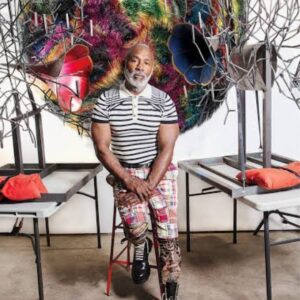
Nick Cave (b. 1959, Fulton, MO) is an artist, educator, and foremost a messenger, working between the visual and performing arts through a wide range of mediums including sculpture, installation, video, sound, and performance. Cave is well known for his Soundsuits, sculptural forms based on the scale of his body, initially created in direct response to the police beating of Rodney King in 1991. Soundsuits camouflage the body, masking and creating a second skin that conceals race, gender, and class, forcing the viewer to look without judgment. They serve as a visual embodiment of social justice that represent both brutality and empowerment.
Chicago-based artist Nick Cave produces work in a wide range of mediums, including sculpture, installation, video, and performance. His creations, bursting with color and texture, are optical delights that can be enjoyed by audiences of all ages and backgrounds. A deeper look reveals that they speak to issues surrounding identity and social justice, specifically race, gun violence, and civic responsibility. His trademark human-shaped sculptures—called soundsuits because of the noise made when they move—began as a response to the beating of Rodney King by policemen in Los Angeles more than 25 years ago. As an African-American man, Cave felt particularly vulnerable after the incident, so he formed a type of armor that protected him from profiling by concealing race, gender, and class. Along with broadcasting an increasingly urgent call for equity, Cave wants his art to spark viewers’ imaginations and aspirations. Cave’s Feat. was on view at the Museum October 16, 2019-February 16, 2020.
2018 Artist-in-Residence: Jeffrey Gibson
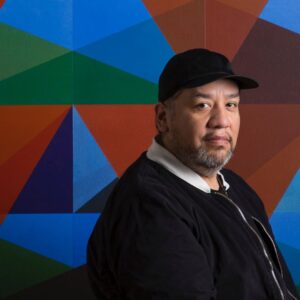
Jeffrey Gibson (b. 1972, Colorado Springs, Colorado; lives and works in New York State) grew up in major urban centers in the United States, Germany, Korea, and England. A mid-career multidisciplinary artist, he is a citizen of the Mississippi Band of Choctaw Indians and is half Cherokee. He incorporates this heritage into his work, which includes sculptures, paintings, prints, and video. Gibson earned his M.A. in painting at the Royal College of Art, London, in 1998 and his B.F.A. in painting from the School of the Art Institute of Chicago in 1995. He has worked in the permanent collections of the Denver Art Museum; National Museum of the American Indian; National Gallery of Canada; Crystal Bridges Museum of American Art; the Museum of Fine Arts, Boston; and the Mississippi Museum of Art; among others. Gibson is a member of the faculty at Bard College, a past TED Foundation Fellow, and a Joan Mitchell Grant recipient.
Over the course of summer and fall of 2018, he created a new video artwork as part of a Jackson, Mississippi-based national artist residency program supported by the Mississippi Museum of Art and CAPE. The artwork, Wonderlust, debuted at a mini-symposium entitled Wonderlust: Materiality & Movement in Mississippi, held November 3, 2018. Gibson’s mid-career survey exhibition, Jeffrey Gibson: Like A Hammer, was on view at the Museum September 8, 2018-January 27, 2019.
2019 Artists-in-Residence: Mark Geil
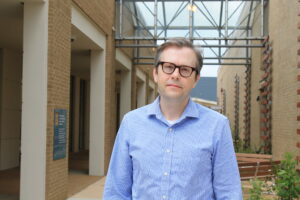
Artist Mark Geil’s residency focused on the creation of a 360-degree photographic “quilt” of the communities in Hancock County. This project used 360-degree cameras and the metaphor of a community quilt to explore the varied narratives and histories of Hancock County. The final product was a centralized online repository for all of the videos. The equipment purchased with the grant remains in Hancock County as an educational resource for local artists and students.
2019 Artists-in-Residence: daniel johnson
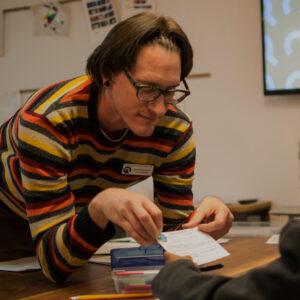
Artist daniel johnson engaged with local Lafayette County organizations and individuals to explore historical narratives highlighting the relationship between land and power. The artist worked with local organizations and hosted a series of meetings to build a multi-faceted cultural program that is interdisciplinary and reflects on land and power in the story of Lafayette County. daniel was able to facilitate an emerging partnership between a local historian of black presence in Lafayette County with the Oxford Artists Guild to produce visual document of this history.
